Hours, prices and access verified by the Fiordland Tours team — last checked 2026-09-21.
Milford Sound, Piopiotahi in Māori, is the fiord most people mean when they
say Fiordland. It is 16 km of water under walls that rise straight out of it, and it is the
only fiord in the park with a road. Here is what you will see from the boat, what is at the
terminal, and what the rain does. When you are ready to book, the
Milford Sound tours are compared on their own page.
Sixteen kilometres to the Tasman Sea
Fact
Figure
Source
Length
16 km from the head of the fiord to the Tasman Sea
DOC
Depth
265 m in places
DOC
Rain
Up to 7 m a year; Visit Fiordland says it has reached 9 m
DOC, Visit Fiordland
The peak above it
1,692 m, straight from the water
DOC
Marine reserve
One of 10 in Fiordland
DOC
Visitors
Over one million a year
DOC
Road access
The only fiord in the park you can drive to
DOC
Cruise length
1 hour 45 minutes to 2 hours on the day boats
The listings
The fiord runs 16 km from the terminal out to the Tasman Sea, and DOC puts it at 265 m
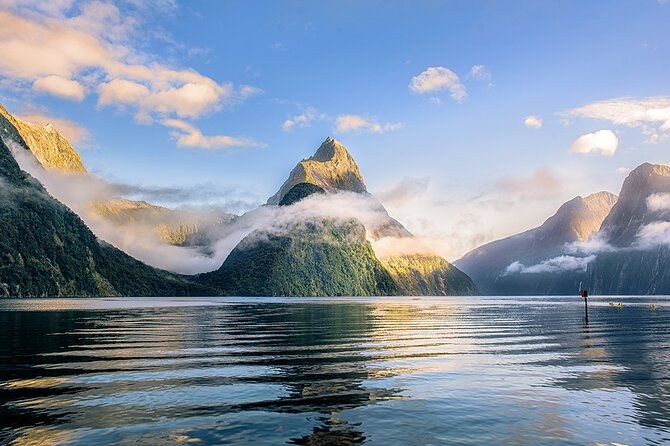
deep in places. Mitre Peak rises 1,692 m from the water on its south shore. The day boats
spend 1 hour 45 minutes to 2 hours on it, and the 2-hour boats go right out past St Anne's
Point into the open sea.
It is a fiord, carved by ice, even though it is called a sound. Glaciers gouged the
U-shaped valleys of the park over the last 2 million years, DOC explains, and the sea filled
them when the ice went.
Piopiotahi, Grono and the City of Milford
Before EuropeansMāori name the fiord Piopiotahi, after the piopio, a native thrush that is probably now extinct. Takiwai greenstone is gathered near its mouth, at Anita Bay.
The sealersWelsh sealer John Grono names it Milford, after Milford Haven in Wales.
1878Donald Sutherland builds three huts at the head of the fiord and calls them the City of Milford.
1889Quintin McKinnon and Donald Sutherland open the Milford Track, and William Homer finds the saddle the road tunnel later goes through.
1935Work begins on the Homer Tunnel. It opens in the 1950s and carries the road to Milford.
1952Fiordland National Park is established. World Heritage status follows in 1986.
2025–26DOC records a record December and January. December day-cruise passengers are up 13% on the year before.
You can see the old story from the water. The head of the fiord, where Sutherland built
his huts, is where the terminal and the lodge stand now. The Milford Track still ends there,
at Sandfly Point, with a short boat across.
Waterfalls you pass on the cruise
Lady Bowen Falls
The first waterfall the 2-hour boats name after they leave the wharf, just after Mitre Peak.
Stirling Falls
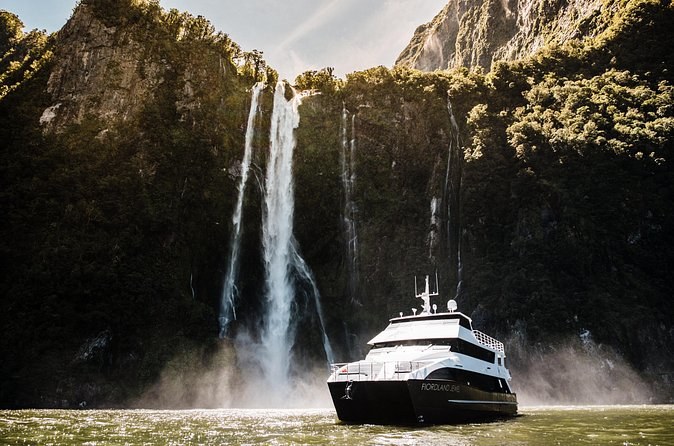
The waterfall the boats nose in close to. The 2-hour cruise comes “close in at Stirling Falls” on the way back, and the plane-and-boat day names it too.
After heavy rain
Temporary falls run down the walls. Visit Fiordland says the fiord is “particularly dramatic on rainy days when mist and waterfalls are on full display.”
The two named falls are there in any weather. What changes is everything between them.
On a dry day you see a few ribbons of water. After a night of rain you see the walls running
white, which is why so many travellers rate a wet day on the fiord above a clear one. Stirling
Falls is the one to be on deck for.
A dark-hulled boat nosing into the spray at the foot of a tall waterfall
Seals, dolphins and penguins
Fur seals
Kekeno haul out on the rocks. The 2-hour boats pass Seal Rock, and Cruise Milford says to look for them.
Dolphins
Pods come in from the open sea on some days, not every day. Cruise Milford lists them as something to look for.
Penguins
Cruise Milford lists penguins too. Tawaki, the Fiordland crested penguin, breed in the park, and DOC names them among its wildlife.
Kea
The alpine parrot waits at the Homer Tunnel on the drive in. DOC asks you not to feed them.
No boat can promise you an animal. Seals are the most reliable sighting, because they rest
on the same rocks. Dolphins and penguins are a matter of luck on the day, so treat them as a
bonus rather than a reason to pick one cruise over another.
The water below the water: the marine reserve
The rain does something you cannot see from the deck. So much fresh water pours off the
walls that it lies on top of the sea as a separate layer, stained the colour of tea by the
forest. Light struggles through it, so creatures that usually live far down grow here in a
band about 40 m deep on the walls. DOC calls this deep-water emergence.
The Piopiotahi (Milford Sound) Marine Reserve protects part of the fiord. It is one of 10
marine reserves in Fiordland. Fishing is not allowed inside a reserve, and you can see why
from the deck: the walls drop away below you into water 265 m deep.
At the terminal: check-in, food, toilets, parking
At the terminal
What to expect
Good to know
Check-in
At your operator's counter inside the Milford Sound Visitor Terminal
Cruise Milford is the second counter on the left
Main car park
NZ$10 an hour, by card at the machines
About 10 minutes' walk to the terminal
Free car park
Deepwater Basin
About 40 minutes' walk
Overnight parking
NZ$30 from 2pm
For the overnight cruise
Disability parking
Outside the terminal
The listings name it
Food on the small boats
None sold
Bring your own
Food elsewhere
Cafés at Milford Sound
No shops or fuel on the road from Te Anau
Toilets
Public toilets at Milford Sound
The others are at Te Anau and Knobs Flat
Phone signal
Yes, at Milford Sound
Also at Te Anau Downs, Totara Campsite and The Divide
You check in at your own operator's counter inside the Milford Sound Visitor Terminal. If
you drive, DOC's advice is to allow at least two hours from Te Anau and 45 minutes to park
and walk in. The small boats sell no food, so bring lunch with you. The drive itself, stop by
stop, is on getting to Fiordland.
Rather not drive the road yourself?
A coach day from Te Anau or Queenstown, a plane in, or a cruise you board at the terminal: see the Milford Sound days side by side.
Over one million people a year visit Milford Sound, DOC says. Visitor numbers doubled
between 2012 and 2018, from 437,000 to 883,000. The summer of 2025–26 set a record for
December and January, and overall visits are now 6% above the pre-COVID peak.
The busy season on the road runs from October to April, so book ahead if you travel
then. DOC also notes that a guided tour or a coach is a good way to cut your footprint.
When the rain comes
DOC records up to 7 m of rain a year here, and the cruises sail in it. Rain is not a
reason to cancel: it is when the waterfalls are at their biggest. What rain can stop is the
flight, because the small planes need to see the passes. A flight cancelled for weather is
rebooked or refunded.
The road is the other thing weather closes. Snow, avalanche risk and rockfall can shut
the Milford Road, most often from May to November. Month by month, the detail is on
the Fiordland weather page.
If the ground shakes
DOC says a large earthquake during your visit is extremely unlikely. It still asks every
visitor to know what to do, because a quake can start a landslide into the fiord and send a
wave along it.
Long or strong shaking: if the shaking is long or strong, do not wait
for an official warning.
Get GONE: head up and away from the water, on foot, straight away.
On a boat, follow the crew's instructions. They brief you before you sail.
Questions about Milford Sound
Why is Milford Sound called a sound?
It was named by the sealer John Grono after Milford Haven in Wales; geologically it is a fiord, carved by glaciers. Its Māori name is Piopiotahi, after the piopio, a native thrush.
How deep is Milford Sound?
Up to 265 m, DOC says. Doubtful Sound goes to 421 m, the deepest of New Zealand's 14 fiords.
How long is a Milford Sound cruise?
Between 1 hour 45 minutes and 2 hours on the day boats. The 2-hour boats run the full 16 km out past St Anne's Point into the Tasman Sea before turning back under Mitre Peak. The overnight boat stays about 17 hours.
What does Piopiotahi mean?
Piopiotahi is the Māori name for the fiord. It comes from the piopio, a native thrush that DOC says is probably now extinct.
Will I see dolphins, seals or penguins?
Often, but no tour can promise it. Fur seals bask on the rocks in Milford Sound, and Doubtful Sound has one of the southernmost populations of bottlenose dolphins. Fiordland crested penguins, tawaki, are seasonal.
Is food available on the Milford Sound cruises?
Not on the small day boats: Cruise Milford and Mitre Peak Cruises sell no food, though they serve tea and coffee and you can bring your own. The small-group coach days from Queenstown and the walks day from Te Anau include a picnic lunch. On Doubtful Sound, RealNZ's boats sell food and drinks, card only.
How much does parking cost at Milford Sound?
The main car park costs NZ$10 an hour, paid by card at the machines, about 10 minutes' walk from the terminal. A free car park at Deepwater Basin is about 40 minutes' walk away. DOC advises allowing 45 minutes to park and walk in before your cruise.
Is there mobile signal at Milford Sound?
Limited. DOC lists reception at Te Anau Downs, Totara Campsite, The Divide and Milford Sound, and little else between Te Anau and the terminal.
Where these facts come from
The size, depth, rain, marine reserve, history, visitor numbers and earthquake advice are
the Department of Conservation's, checked 21 September 2026; the rainy-day line is Visit Fiordland's. The
waterfalls, the wildlife, the counters, the parking and the food rules come from each
cruise's own listing.
Thirteen hours from Queenstown with 15 guests at most, a picnic lunch, road stops at the lakes and in the valley, and a boutique cruise on the fiord. A flight home can be added when you book.
Two hours on a small boat, the full length of the fiord past the point and out to the open sea, close in at the falls on the way back. Tea, coffee and hot chocolate on board; bring your own food.