Fiordland Facts That Surprise Most Visitors
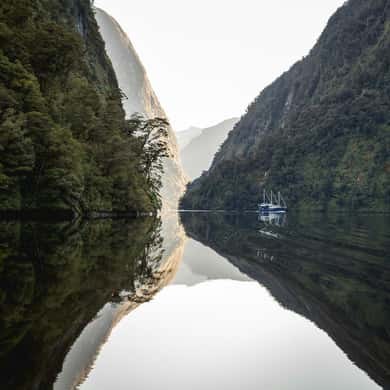
The short answer. Fiordland is a park of 1.26 million hectares with 14 fiords, a lake deeper than any other in New Zealand, and up to 7 m of rain a year. The rain lays a layer of fresh water on the sea, which lets deep-water life grow near the surface. You will most likely see it on Fiordland National Park tours to the two famous fiords.
The park in figures
| Fact | Figure | Source |
|---|---|---|
| Area | 1,260,740 hectares | DOC |
| Established | 1952 | DOC |
| World Heritage | Since 1986 | DOC |
| Fiords | 14 | DOC |
| Deepest lake | Lake Hauroko, 462 m | DOC |
| Deepest fiord | Doubtful Sound, 421 m | DOC |
| Rain at the head of the fiord | Up to 7 m a year | DOC |
| Visitors to the northern fiord | Over one million a year | DOC |
The water is two layers
1. A freshwater lid on the sea
So much rain runs off the mountains that the fiords carry a permanent layer of fresh water on top of the salt. It is stained the colour of tea, and it blocks much of the light. You see it from the boat as dark, still water, even on a sunny day.
2. Deep-sea life a few metres down
Because the dark layer cuts out the light, creatures that normally live far down in the ocean grow close to the surface. DOC describes a 40 m band of deep-water life on the fiord walls, which scientists call deep-water emergence.
3. The deepest of the fiords is the quiet one
Doubtful Sound is 421 m deep, the deepest of New Zealand's 14 fiords, and 40 km long. Milford Sound, the famous one, is 265 m at its deepest and 16 km long. If you want the bigger fiord, it is the quiet one, and you cannot drive to it. Martin, from the United Kingdom, found it a better day than Milford Sound. The crossing is on the Doubtful Sound page.
4. A lake deeper than both
Lake Hauroko, in the south of the park, is 462 m deep, deeper than any fiord and the deepest lake in New Zealand. Lake Te Anau, the lake the town sits on, holds more fresh water than any other lake in Australasia.
The rain is the point
5. Up to 7 m of rain a year
DOC puts the rain at Milford Sound at up to 7 m a year, on about 200 days. Visit Fiordland says it has been known to reach 9 m. Tom went to Doubtful Sound after heavy rain and counted hundreds of waterfalls, at the price of cloud and mist.
6. Winter is the settled season
If you can travel in winter, June to August is often the calmest time, with clear, cold days for your cruise. Spring, around the equinox, brings the most wind and rain. The month-by-month figures are on Fiordland weather.
The names tell the story
7. Named for a bird that has vanished
The Māori name for Milford Sound, Piopiotahi, comes from the piopio, a native thrush that is probably now extinct. The English name came from a Welsh sealer, John Grono, who named it after Milford Haven at home.
8. The place of silence, and the captain's doubt
Doubtful Sound's Māori name, Patea, is usually translated as the place of silence. Captain Cook passed its mouth in 1770 and named it Doubtful Harbour, doubting that the ship could sail back out against the westerly. In 1773 Cook's ship spent five weeks in Tamatea, or Dusky Sound, further south.
9. A peak named after a bishop's hat
From the boat you look up at Mitre Peak, 1,692 m straight from the water. It was named for its likeness, seen from the south, to a bishop's mitre, and it is five separate peaks grouped together rather than a single spire. Its name and its first climb are on the Mitre Peak page.
10. Carved by a demigod, then by ice
In Māori tradition the demigod Tū Te Rakiwhānoa carved this landscape, shaping the fiords and the mountains between them. Geologists give the job to glaciers, which cut the deep U-shaped valleys over the last two million years and left the sea to fill them.
11. Greenstone at the mouth of the fiord
Near the mouth of Milford Sound, at Anita Bay, Māori gathered takiwai, a kind of pounamu, or greenstone. The piece of coast that looks empty from the boat was once a place people travelled a long way to reach.
Roads, tracks and people
12. A road with no link to any other
The road over Wilmot Pass, 671 m high, runs from West Arm on Lake Manapouri to Deep Cove. It is not joined to any other road in the country. A private car needs a permit and a barge from Supply Bay that usually sails only on Wednesdays, so you cross it in a coach, as part of the Doubtful Sound day from Manapouri.
13. A tunnel begun in 1935
Your road into Milford Sound goes through the Homer Tunnel, 1.2 km long and 945 m above the sea. William Homer found the saddle in 1889, and digging began in 1935. Overland, the old way in was on foot, by the route Quintin McKinnon and Donald Sutherland opened in 1889: the Milford Track.
14. A city of three huts
In 1878 Donald Sutherland built three huts at the head of the fiord and called them the City of Milford. When you arrive, the settlement is still little more than the terminal, a lodge and the airstrip.
15. One of the most-visited places in the country
Visitors to Milford Sound doubled from 437,000 in 2012 to 883,000 in 2018, and today top a million a year. December 2025 alone carried 12,117 more day-cruise passengers than the December before.
16. Part of something far bigger
The park belongs to Te Wāhipounamu, the South West New Zealand World Heritage Area. At 2.6 million hectares it covers almost 10% of New Zealand's land and four national parks. Kea and takahē live there, and three kinds of kiwi found nowhere else. The rules for visiting are in the Fiordland visitor guide.
17. The river from the films
The Waiau River, between Lake Te Anau and Lake Manapouri, played the River Anduin in The Lord of the Rings, and the Kepler Mire stood in for the Dead Marshes. You can ride that river down to the lake on the jet boat ride.
Five facts to take with you
- You cannot bring a dog into the park, even inside a car.
- Sutherland Falls, on the Milford Track, drops 580 m in three leaps.
- The glowworm caves across Lake Te Anau are about 12,000 years old.
- Bottlenose dolphins in Doubtful Sound are one of the southernmost groups in the world.
- The fiords were carved by glaciers over the last two million years.
To see the layered water, the walls and the falls for yourself, the Doubtful Sound overnight cruise gives you a whole evening on the fiord, and the boutique cruise does Milford Sound in under two hours. Nathan, after six months travelling the country, would choose the overnight over Milford Sound. More ways to spend your days are on things to do in Fiordland.
Days on the quieter fiord
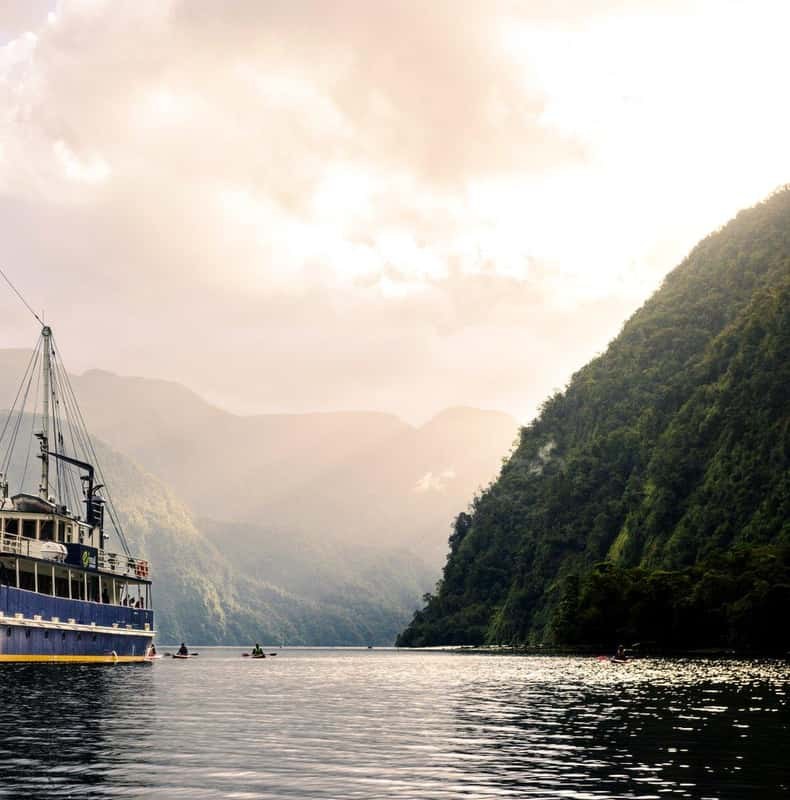
From Manapouri: Doubtful Sound Overnight Cruise
A night on the quiet fiord: the lake and the pass, a cruise on the Wanderer, kayaks or a tender boat, a three-course dinner and a hot breakfast. Full refund up to 14 days before.
From $428 per person
Check Availability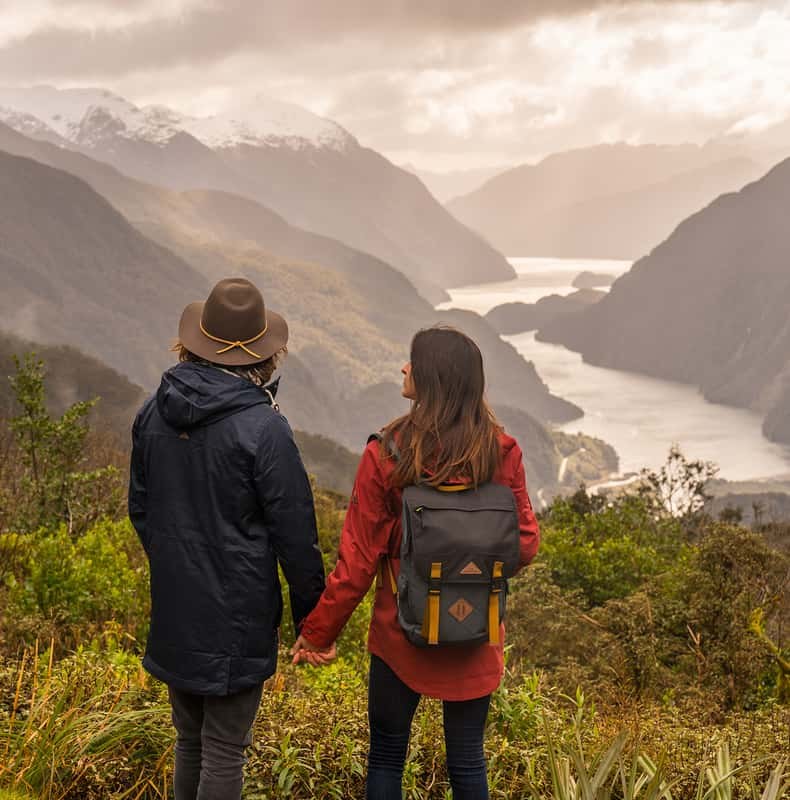
From Te Anau: Doubtful Sound Coach & Cruise
The quiet fiord from Te Anau in 8 hours 30 minutes: coach to Manapouri, the lake crossing, the pass by coach with photo stops, and three hours on the water.
From $218 per person
Check Availability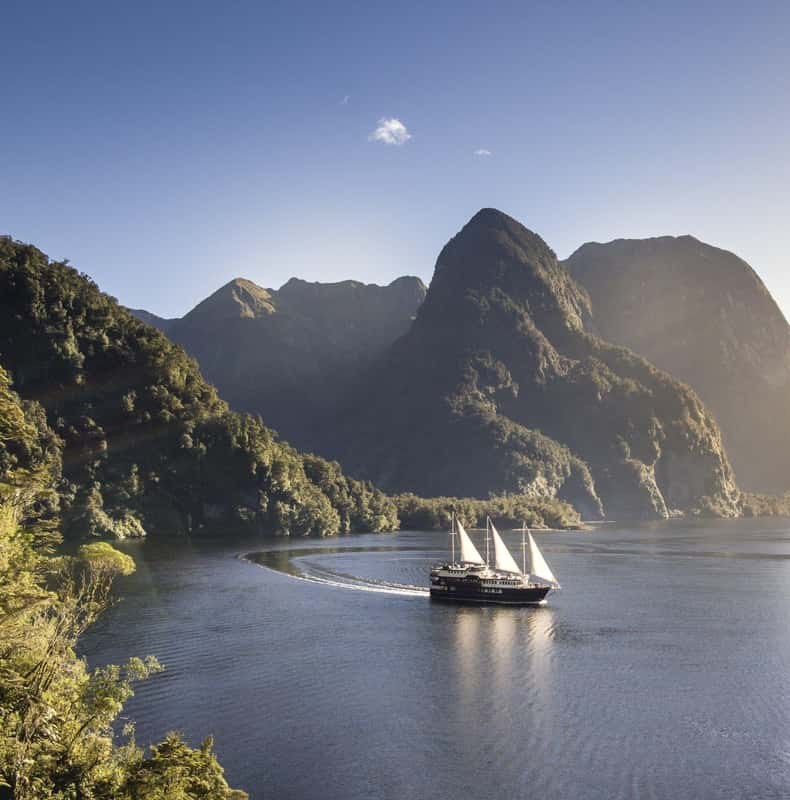
From Queenstown: Doubtful Sound Wilderness Day Trip
The quiet fiord in a day from Queenstown: 13 hours by coach, lake boat and the pass, with three hours on the water. Food and drinks on sale on board, card only.
From $273 per person
Check AvailabilityNext: Put the facts to use and plan the day with our guide to visiting the fiord. Every fare sits side by side on Fiordland Tours.